Traditional Bookkeeping VS Real Estate Bookkeeping: How the Right Approach Saves You Money
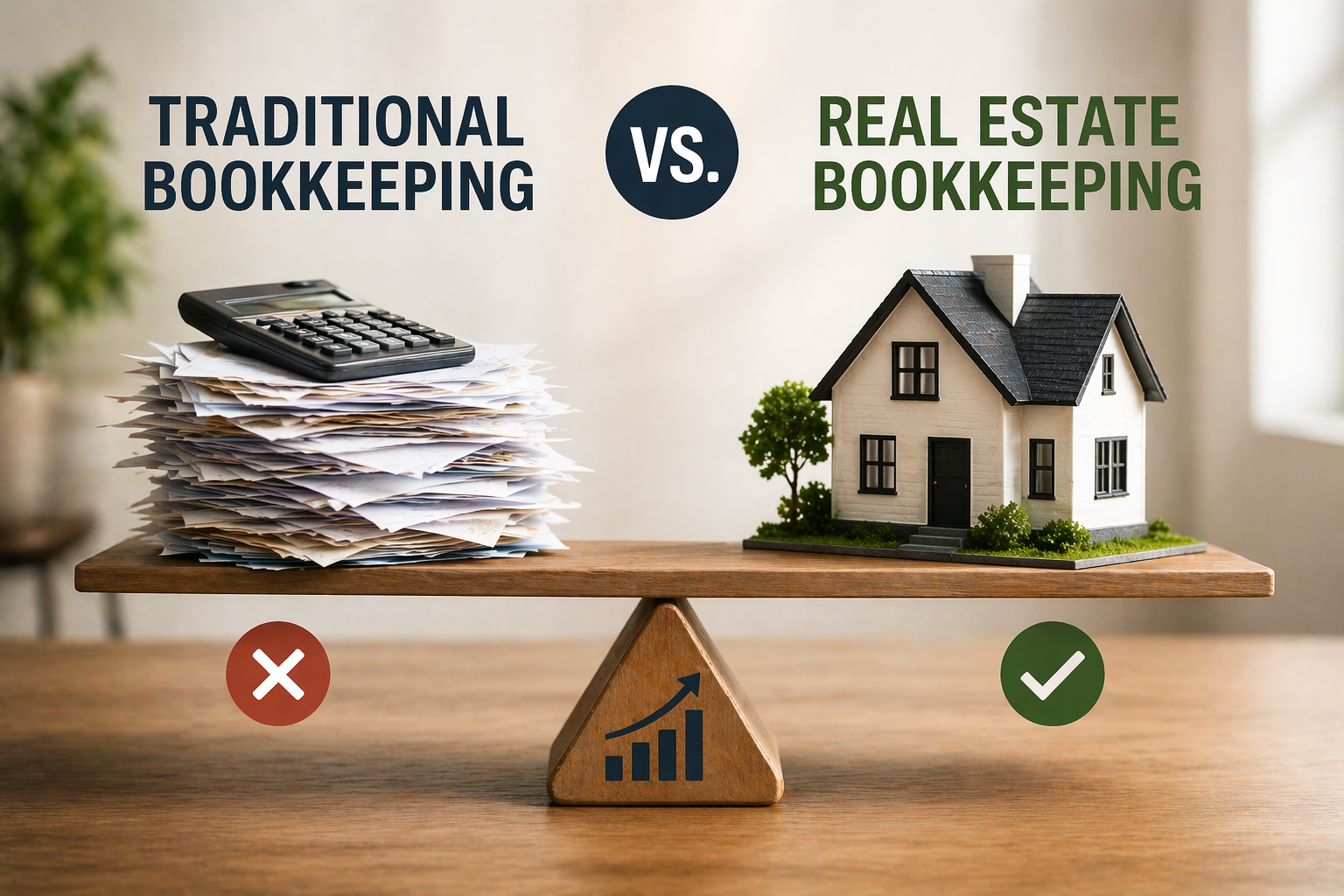
If you own rental properties, your finances are not the same as a typical small business. However, many landlords still rely on traditional bookkeeping services that treat rental activity like any other business. That disconnect can lead to missed tax opportunities, unclear financials, and ultimately paying more in taxes than necessary.
Real estate bookkeeping is not just a niche version of general bookkeeping. It is a fundamentally different system designed to match how the IRS treats rental income and how investors actually operate.
Rental Activity Is NOT a Typical Business
The IRS does not treat rental income the same way it treats most business income, and this difference drives everything about how your books should be structured.
Schedule E vs. Schedule C
Most small businesses report income on Schedule C, where profits are considered earned income and subject to self-employment tax.
Rental income is reported on:
Schedule E (Supplemental Income and Loss)
This creates several important differences:
Rental income is generally considered passive
It is typically not subject to self-employment tax
Losses are subject to passive activity limitations
Depreciation becomes a major factor in reducing taxable income
If your bookkeeping is set up like a Schedule C business, your financials may not align properly with how your taxes are actually filed.
Partnerships and Form 8825
If you own property through an LLC taxed as a partnership, rental activity is handled separately from operating income.
Instead of being included with ordinary business income, it is reported on:
Form 8825 (Rental Real Estate Income and Expenses of a Partnership or S Corporation)
This flows into the partnership’s Schedule K and then to each partner.
This matters because:
Rental income is separately stated
It retains its passive classification
Losses and deductions are handled differently at the partner level
Without properly structured books, this reporting becomes more complicated and less efficient.
Where Rental Bookkeeping Actually Saves You Money
The real value of specialized bookkeeping shows up in tax strategy and accuracy. When your books are structured correctly, you are able to take advantage of opportunities that are often missed.
Depreciation and Cost Segregation
Depreciation is one of the largest tax benefits available to real estate investors. A specialized bookkeeping system ensures that:
Assets are categorized correctly
Improvements are tracked separately from repairs
Your records are ready for cost segregation studies
Cost segregation can accelerate depreciation and create large deductions earlier in the life of a property, but it depends on clean and detailed records.
Repair vs. Capital Expense Classification
One of the most common and costly mistakes in real estate is misclassifying expenses.
Repairs are typically fully deductible in the year incurred
Capital improvements must be depreciated over time
A general bookkeeper may not apply these rules correctly. This can either increase your tax bill or create unnecessary audit risk. A real estate specialist understands how to apply IRS guidelines and document these decisions properly.
Understanding Passive Loss Rules and Their Exceptions
Rental real estate is generally considered a passive activity, which means losses cannot always be used to offset active income like W-2 wages or business income. However, there are important exceptions that can significantly reduce your tax liability if properly tracked and applied.
The $25,000 Active Participation Exception
If you actively participate in your rental (making management decisions, approving tenants, etc.), you may be able to deduct up to $25,000 in rental losses against ordinary income.
This benefit phases out between $100,000 and $150,000 of modified adjusted gross income
Proper documentation and classification are critical to qualifying
Real Estate Professional Status (REPS)
If you or your spouse qualify as a real estate professional, rental activities can be treated as non-passive, allowing losses to offset active income.
Requires meeting strict time and participation tests
Requires proper grouping and tracking of activities
Short Term Rental Exception
Short term rentals can fall outside traditional passive activity rules if:
The average guest stay is 7 days or less (or in some cases 30 days with significant services)
You materially participate in the activity
When structured correctly, this can allow losses to offset active income without needing real estate professional status.
These opportunities are powerful, but they depend entirely on having accurate, well-organized books that support the classification and reporting.
Passive Loss Tracking
Even when losses cannot be used immediately, they are not lost.
A specialized system ensures:
Losses are tracked correctly by property
Carryforwards are documented and preserved
You are positioned to use those losses in future years or upon sale
If losses are not tracked properly, they can be underutilized or lost entirely.
Expense Categorization That Matches Tax Reporting
Real estate has unique expense categories that need to be clearly separated, such as:
Property management fees
Cleaning and turnover costs
Platform fees for short term rentals
Utilities and maintenance by property
Insurance and property taxes
Accurate categorization ensures your tax return is complete, defensible, and optimized.
Property Level Tracking Is Essential
Traditional bookkeeping often provides one set of financials for the entire business. That approach does not work for real estate investing.
Each property should be tracked individually so you can see:
Profitability by property
Cash flow trends
Expense patterns
Return on investment
Without this level of detail, it is difficult to make informed decisions about buying, selling, or improving properties.
Different Rental Strategies Require Different Systems
Real estate investors often operate across multiple rental strategies, each with its own financial and tax considerations.
Short term rentals
High transaction volume
Platform and cleaning expenses
Potential for different tax treatment
Long term rentals
Stable income
Lower turnover
Typically passive activity
Mid term rentals
Hybrid structure
Unique pricing and occupancy trends
Commercial properties
More complex leases
Shared expenses and reimbursements
A traditional bookkeeping setup does not separate these properly, which limits both insight and tax efficiency.
Why Traditional Bookkeeping Falls Short
A general bookkeeper is trained to keep records accurate and up to date. That is important, but it is not enough for real estate investors.
Traditional bookkeeping often lacks:
Alignment with Schedule E and Form 8825
Property level reporting
Understanding of real estate tax strategy
Proper handling of depreciation and capital expenses
The result is clean records that do not provide the information needed to reduce taxes or grow a portfolio.
Why Vestora Supports Real Estate Investors
Vestora was designed specifically to solve these problems for landlords and real estate investors. By firmly servicing this niche, we are able to provide specialized solutions for our clients.
A Structure Built for Real Estate
We can set your books up to align with schedule E reporting for your personal return, Form 8825 for partnerships, and real estate specific expense categories.
Clear Property and Strategy Tracking
Vestora can help you track each property individually, differentiate between rental strategies, and understand performance metrics that help optimize your real estate portfolio instead of treating it like a normal business.
Tax Ready Financials
Instead of requiring cleanup at year end, Vestora provides:
Organized, accurate records
Proper categorization for deductions
Financials that your CPA can use immediately
A System That Supports Growth
As your portfolio expands, your financial system needs to scale with it. Vestora provides the structure and insight needed to:
Evaluate new investments
Monitor performance
Plan for future tax strategies
What This Means For You
The difference between traditional bookkeeping and real estate bookkeeping is not just technical. It directly impacts how much you pay in taxes and how well you understand your investments.
When your books are structured correctly, you gain:
Better tax outcomes
Clearer financial insight
Stronger decision making
Real estate investing is a data driven business. The right bookkeeping system turns that data into an advantage.